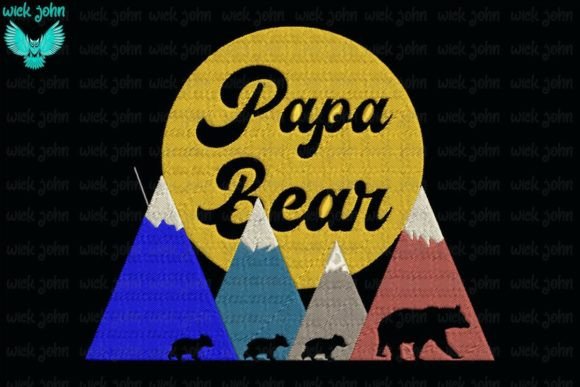
Papa Bear Design Review for Small Business Merch
As an experienced embroidery designer who has reviewed thousands of digital files for commercial use, I approach every new asset with a critical eye toward scalability, brand consistency, and production reliability. Today, I am reviewing the Papa Bear machine embroidery design. The product description suggests it is "the perfect way to decorate your beautiful embroidery projects" and looks nice on clothes, home decor, or Father's Day gifts. While this sounds promising for the holiday season, my review focuses on how this design performs as a core element for small business merchandise, branded patches, and professional uniforms.
First Impressions: Personality and Brand Fit
The title Papa Bear immediately evokes a sense of warmth, protection, and rustic charm. For a small business owner looking to humanize their brand, this design feels friendly, playful, and slightly handmade. It avoids the sterile look of corporate vector graphics, offering instead a visual personality that resonates with crafters, boutique owners, and local artisans. If your brand identity relies on being approachable, family-oriented, or rooted in tradition, Papa Bear fits seamlessly into that narrative.
However, the term "decorative" in the description raises a flag for serious commercial application. A design intended merely for decoration often lacks the structural integrity required for high-volume production. In my experience, a successful design for custom apparel must balance artistic flair with technical precision. Does Papa Bear feel like a logo that can stand alone on a cap front, or does it require a complex background to look good? The initial assessment suggests it leans towards a charming accent piece rather than a bold primary logo, making it ideal for secondary branding elements.
Real-World Application in Commercial Embroidery
When evaluating this file for actual business use, the versatility of Papa Bear shines in specific scenarios. Imagine a local bakery wanting to add a touch of whimsy to their staff aprons. This design could serve as a delightful chest logo or a subtle detail on the pocket, reinforcing the homemade quality of their goods. Similarly, for a pet brand or a florist shop, placing Papa Bear on tote bags or customer gift tags creates an emotional connection that drives engagement.
For embroidered patch applications, this design offers significant potential. Patches are a staple for small business merch, allowing brands to attach logos to hats, jackets, and backpacks without the cost of re-printing entire garments. If the stitch density is appropriate, Papa Bear can be converted into a durable iron-on or sew-on patch. This makes it a valuable asset for event merchandise, trade show giveaways, or loyalty programs where customers receive a branded item after a certain number of purchases.
I also see strong utility in cap embroidery. The rounded shape of a bear motif often works well on the curved surface of a baseball cap, provided the design is not overly wide. As a sleeve detail or a back-of-collar accent, it adds a premium touch to work shirts. Furthermore, for Etsy sellers and digital file buyers, this design serves as a versatile design asset that can be used to create printable mockups, helping clients visualize the final finished product before committing to bulk production.
Strategic Limitations and Production Risks
Despite its charm, there are areas where Papa Bear requires careful consideration. The most critical factor is scale. When reduced to a tiny size for a wristband or a small label, intricate details in a bear design can blur or merge, losing the character that makes it appealing. I advise testing the design at the smallest intended size before launching a campaign.
Curved surfaces present another challenge. While caps are great for branding, designs with sharp angles or fine outlines can distort when stitched around the curve of a hat. If Papa Bear features detailed outlines or small text, these elements may become illegible on tight curves. Additionally, high stitch density can make the fabric stiff, which is undesirable for soft items like baby onesies or lightweight t-shirts. On dark uniforms, thread color contrast becomes paramount; if the design relies on light shading against a dark background, the effect may be lost without a high-quality underlay.
Fabric texture also plays a role. Embroidering on textured materials like denim or canvas can hide some of the finer details of the bear motif. Conversely, on slippery fabrics like polyester blends, the design might pucker if the stabilizer choice is incorrect. Items that need frequent washing, such as chef aprons or work shirts, require a robust design. If the stitching is too loose or the density too low, the design may degrade quickly, harming the perceived value of the brand.
Impact on Brand Identity and Customer Trust
In the world of handmade products and boutique retail, visual consistency is key to building trust. A poorly executed embroidery job can signal a lack of professionalism, even if the product itself is high quality. Using a well-balanced design like Papa Bear can elevate the perceived value of your items. It signals that you care about the details, which translates to customer confidence in your overall service.
When used correctly, Papa Bear enhances brand recognition. Customers remember the feeling of wearing a soft, well-made garment with a cute, recognizable motif. This emotional attachment fosters loyalty. However, if the design is applied inconsistently—such as varying sizes or poor thread choices across different products—it dilutes the brand message. The goal is to ensure that whether a customer sees Papa Bear on a tote bag, a patch, or a uniform, they instantly recognize it as part of your cohesive visual language.
Essential Designer Notes for Production
Before integrating Papa Bear into your production line, follow these practical steps to ensure success. First, always test the design in black and white. This helps verify that the shapes hold up without relying on specific thread colors to define them. Next, check the spacing and confirm the hoop size requirements. A design that fits a 4x4 hoop will perform differently than one requiring a larger frame.
Inspect the stitch density carefully. High density is necessary for durability but can cause puckering on thin fabrics. Use the proper stabilizer to support the fabric during stitching; this is non-negotiable for clean results. Create a printable mockup for client approval to manage expectations regarding how the design will look on the final material. Compare it beside other design assets in your collection to ensure it matches the style and weight of your existing logo suite.
Finally, confirm the commercial licensing terms. Just because a file is available for purchase does not automatically grant the right to sell finished goods bearing the design. Verify that you have the necessary rights for commercial embroidery before mass-producing items. If the product description does not explicitly state the stitch count, file format, or license terms, contact the creator directly. Do not guess these details, as they dictate the feasibility of your project.
By approaching Papa Bear with a strategic mindset, small business owners can transform a simple decorative file into a powerful tool for brand growth. Whether used for Father S Day collections or year-round embroidery projects, the key lies in execution. Test thoroughly, choose the right materials, and maintain a consistent vision to turn this charming design into a profitable asset for your enterprise.